
Article guide
Buying Guide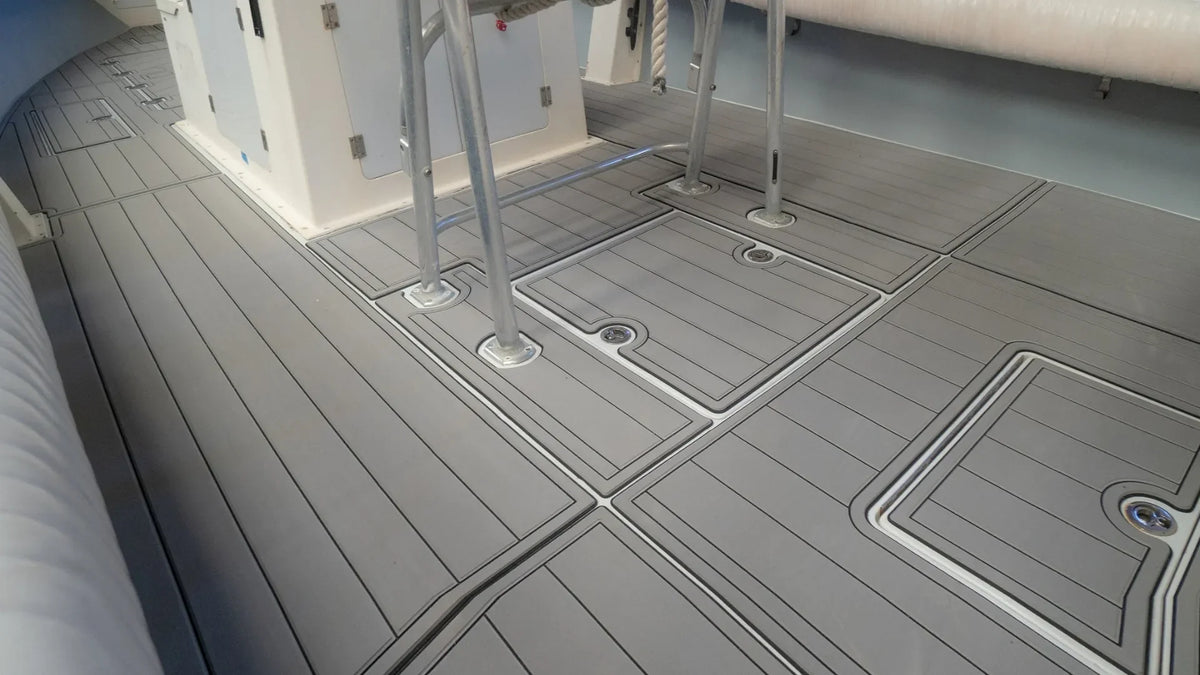
Article guide
Buying GuideUpdated August 2026
PoseidonDeck is not affiliated with, endorsed by or sponsored by SeaDek or DEKit. SeaDek and DEKit are separate brands. Product specifications, dealer coverage, prices and policies can change, so confirm current details with each provider before ordering.
There is no universal winner between SeaDek, DEKit and other EVA foam boat flooring. The right choice depends on whether you want a branded professional custom project, a verified pre-cut kit, a template-based custom layout or universal cut-to-fit sheets that you measure and install yourself.
The most important comparison is not only the brand name. It is the complete project route: who measures the boat, who creates the panel geometry, what arrives in the package, who installs it, how the substrate is prepared and what happens if a panel needs replacement later.
| Option | Common buying paths | Best starting point for | Main responsibility to verify |
|---|---|---|---|
| SeaDek | Professional custom projects, branded kits where available and DIY sheet material | Buyers who specifically want the SeaDek brand or its official custom and sheet-material channels | Exact fitment route, local provider scope, current material specification and installation responsibility |
| DEKit | Custom manufacturing and installation services, plus selected DIY full-sheet products | Buyers who specifically want DEKit styling, custom services or a listed DIY sheet format | Project scope, measurement process, current sheet specification, customization and installation arrangement |
| Universal EVA foam sheets | Ready-stock adhesive-backed sheets cut by the owner or installer | Simple deck zones, localized upgrades and budget-controlled DIY projects | Actual dimensions, sheet layout, substrate condition, adhesive option, cutting and installation |
| Template-based custom EVA panels | Panels designed from an accurate physical template or verified digital source | Curves, fitted hatches, routed borders, logos and coordinated multi-panel layouts | Accuracy of the source template, panel labels, hardware locations and final installation |
Official brand information reviewed for this guide shows that SeaDek offers both custom-project routes and DIY sheet material, while DEKit presents both custom boat-flooring services and DIY full sheets. That means neither brand should be described as only a professional system or only a sheet supplier. The exact route must be confirmed for the specific project.
Boat owners often search for “SeaDek vs DEKit” when they are actually comparing several different decisions at once:
A professionally measured custom project should not be compared only by its material price with an uncut universal sheet. The custom route includes additional work and risk management. Likewise, a ready-stock sheet can be a practical choice for a simple rectangle even when a full custom system would produce a more detailed fitted appearance.
For a broader explanation of these formats, read boat flooring kits vs EVA sheets vs custom-cut mats.
The complexity of the deck is the first decision point. A universal sheet may be appropriate for a helm standing area, straight walkway, cockpit rectangle, step, cooler pad or another manageable zone. It becomes more difficult when the project includes many hatch lids, compound curves, closely fitted hardware, routed borders, drains, pedestal bases and multiple panels that must align visually.
| Deck condition | Likely route | Why |
|---|---|---|
| One or two simple sections | Universal cut-to-fit sheet | The owner can usually measure, dry fit and trim the pieces without a full custom drawing |
| Many rectangular panels with clear boundaries | Universal sheets or a verified kit | Sheet nesting and pattern direction matter, but geometry may remain manageable |
| Compound curves and tightly fitted hatches | Professional measurement or template-based custom panels | Small errors become visible and can interfere with moving parts |
| Known boat model with an explicitly verified kit | Model-specific kit | Only when year, model, layout and options are confirmed by the seller |
| Soft, corroded or unstable deck | Repair before flooring | EVA is a surface covering and cannot correct structural damage |
Do not assume that a product fits because the listing photo shows a similar boat. Even boats sharing a model name can vary by year, factory option, hardware placement, prior repair or owner modification.
Measurement responsibility is one of the largest differences between buying routes.
A professional route may include measurement, pattern development, design consultation, panel manufacturing and installation. Confirm exactly which steps are included. A quote for material only is not the same as a quote for a completed installed project.
A pre-cut kit can reduce cutting work, but only when its fitment is explicitly verified for the exact boat year, model, deck layout and options. Ask whether the kit is produced from an existing pattern, whether a dry fit is required and what happens when the boat differs from the stored geometry.
The owner creates and labels a physical template, and the manufacturer develops panels from that source. This can support a detailed custom result, but the finished fit still depends on the template’s accuracy. Port, starboard, bow, stern, top, bottom, hatch clearance and reference points must be unmistakable.
The owner or installer assumes responsibility for dimensions, panel layout, cutting and fit. This route provides the most control for simple projects but also places more planning risk on the buyer. Use the boat deck measurement guide and complete a dry layout before ordering.
Thickness is easy to advertise, but it does not describe the entire material. Compare the construction, density, hardness, texture, edge design, adhesive backing and intended use. A thicker foam is not automatically more durable or more appropriate.
Extra thickness can create clearance problems around doors, hatch lids, controls, pedals, seat bases and transitions. A soft material may feel different underfoot but can also show concentrated compression more readily. A firmer product may feel less cushioned while supporting a different use case.
At the time of this August 2026 review, DEKit’s official DIY full-sheet listing described a 5 mm, 40 × 80 inch brushed sheet. SeaDek’s official store presented multiple sheet-material products and formats. These examples demonstrate why buyers should compare the exact product page, not apply one specification to an entire brand.
For more context, see how to choose EVA foam hardness for boat decking.
Brushed, grooved, diamond and routed surfaces can create different contact patterns and visual styles. However, no EVA flooring should be treated as completely slip-proof. Water, soap, sunscreen, tanning oil, fish residue, algae, mud, fuel film, footwear and wear can change practical grip.
When comparing samples or product descriptions, ask:
PoseidonDeck does not claim that a textured EVA sheet eliminates slipping. Read the texture, water and boat-flooring grip guide for a practical evaluation.
A named adhesive does not compensate for a contaminated or unstable deck. Wax, polish, oil, oxidation, moisture, salt, old adhesive, loose coating and cleaning residue can reduce bonding. The surface must be structurally sound, compatible, clean and fully dry.
Compare the following:
SeaDek and DEKit official DIY listings describe pressure-sensitive or pressure-activated adhesive systems on selected products. PoseidonDeck offers product-dependent backing choices. The important comparison is the exact product and substrate, not a generalized statement that one brand name guarantees every installation.
Review PoseidonDeck adhesive vs 3M adhesive before selecting a backing for a ready-stock sheet.
A DIY project can reduce labor cost and give the owner control over timing, but it requires careful measurement, cutting and surface preparation. A professional project costs more because it can include site work, pattern development, design, fabrication and installation responsibility.
Before choosing DIY only because the material price is lower, read the DIY peel-and-stick installation guide and decide whether the required work matches your tools and experience.
Custom marine decking can include panel borders, routing patterns, layered color reveals, logos, text, hatch numbering and coordinated grain direction. These features require accurate geometry and design approval. Ask whether the quote includes:
Universal sheets offer less factory personalization but can still create a coordinated result when pattern direction, seams and panel spacing are planned consistently. PoseidonDeck ready-stock options include diamond-pattern EVA flooring, faux-teak stripe EVA flooring, camo diamond EVA flooring and solid-color EVA decking.
Do not assume every ready-made product ships immediately or every custom project follows the same schedule. Availability, production queue, measurement appointments, drawing revisions, material selection, installer scheduling and shipping all affect timing.
| Route | Common schedule components | What to ask before payment |
|---|---|---|
| Ready-stock sheet | Inventory confirmation, processing and shipping | Actual stock, selected size, backing, shipping method and delivery estimate |
| Verified pre-cut kit | Fitment confirmation, inventory or production and shipping | Exact boat compatibility and whether the kit is stocked or made to order |
| Owner-template custom project | Template creation, shipping, review, drawing, approval, production and delivery | Template standards, revision process and production timing after approval |
| Professional custom installation | Appointment, measurement, design, fabrication and installation scheduling | Who controls each stage and whether the quoted date is an estimate or confirmed appointment |
Buyers with a fixed launch or trip date should build contingency time into the project and avoid removing usable flooring before replacement material and installation plans are confirmed.
Exact competitor prices change and vary by project, so a durable comparison should focus on cost structure. Include:
A universal sheet may have the lowest starting material cost, but poor measurement can create waste. A custom project may have a higher quoted price while including design or installation work that is absent from a material-only order. Ask for an itemized scope before comparing totals.
Use the EVA boat flooring cost and budget guide and the sheet calculator and layout guide for a ready-stock project.
Closed-cell EVA is water-resistant, but the installed system is not completely waterproof. Open edges, seams, fasteners, drains and damaged areas can allow water to reach the substrate. Regular inspection matters regardless of brand.
Before buying, consider:
Separate panels can simplify future repairs, although a new panel may not visually match material that has aged outdoors. See the EVA boat deck cleaning and long-term care guide.
Warranty and return terms can differ by product, seller, installer and custom status. Do not rely on a general comparison article for a current policy. Before ordering, confirm:
Save the approved drawing, order specification, installation instructions, photographs and packaging until the project has been inspected.
| Your priority | Best route to investigate first | Important limitation |
|---|---|---|
| You specifically want the SeaDek brand | SeaDek official custom, kit or sheet-material channel | Confirm the exact local service and product format rather than assuming every option is available for every boat |
| You specifically want DEKit styling or service | DEKit custom process or its current DIY product catalog | Confirm current dimensions, thickness, colors, service area and installation scope |
| You want a simple, lower-complexity DIY upgrade | Universal ready-stock EVA sheets | The owner assumes measurement, cutting, layout and installation responsibility |
| You need a fitted multi-panel design | Professional measurement or template-based custom panels | The result still depends on accurate geometry and approved design details |
| You only need a helm pad, step or localized mat | Cut-to-fit sheet or separate deck pad | Check controls, drainage, edge exposure and equipment clearance |
| The deck has rot, corrosion or loose coating | Structural and substrate repair first | No EVA product is a substitute for repairing the boat |
Because catalogs and service networks change, check the current official pages before making a brand-specific decision:
PoseidonDeck’s primary route is ready-to-buy universal EVA foam material for boat owners who can measure, plan, cut and install manageable deck zones. Standard PoseidonDeck sheets are not verified model-specific kits unless a product page explicitly states otherwise.
For a PoseidonDeck-focused buying route, read SeaDek Alternative: DIY EVA Foam Boat Flooring Guide. It explains when ready-stock sheets are a practical alternative without claiming that PoseidonDeck is the same brand or service system.
Browse the ready-to-buy EVA boat flooring collection for straightforward DIY projects. For compound curves, routed borders, logos or coordinated hatch panels, review custom boat flooring and provide accurate measurements or a physical template from the actual boat.
Choose by project route before choosing by brand. SeaDek and DEKit both provide branded marine-decking options through more than one purchase format. Universal EVA sheets serve a different buyer: someone willing to accept measurement, cutting and installation responsibility in exchange for greater DIY control.
The strongest decision is the one that matches the actual deck geometry, service level, budget, schedule and installer capability. Verify current specifications and policies, repair structural problems first, and never treat texture or adhesive branding as a substitute for proper surface preparation and safe use.
For remaining questions, use the EVA foam boat flooring FAQ hub or contact PoseidonDeck with photographs and project dimensions.
A practical buyer decision guide based on recurring owner questions about EVA boat flooring comfort, cleaning, heat, stains, adhesive, installation effort, repairs, lifespan and total project cost.
Read moreCompare PoseidonDeck self-developed and 3M adhesive backing options for EVA boat flooring by cost, exposure, surface preparation, installation and project type.
Read moreCompare pre-cut boat flooring kits, universal EVA sheets and custom-cut mats by fit, measuring, installation, cost, risk and best use before ordering.
Read more


Compartir:
Aluminum Boat Flooring: How to Choose and Buy EVA Foam Sheets
Commercial vs Recreational Boat Flooring: Which EVA Decking Fits Best?